The 2008 Crash, Month by Month: ₹1 Crore in Low Volatility vs Nifty 50
Price-only gross returns. No taxes on either side. No dividends on either side. Same crash. Same economy. Same market. The experience was completely different.
📋 QUICK REFERENCE — KEY NUMBERS
- Starting capital: ₹1,00,00,000 (₹1 Crore) — December 31, 2007 peak
- LV strategy: Top 100 NSE by market cap, PE > 0, 30 least volatile stocks (36-month price std dev), annual rebalancing
- Returns basis: Price-only, gross (no taxes, no dividends on either side)
- LV worst point: ₹55,41,000 in February 2009 (−44.6% from peak)
- Nifty worst point: ₹44,88,000 in November 2008 (−55.1% from peak)
- LV recovery: September 2009 — 7 months from its own trough
- Nifty recovery: October 2013 — 59 months from its trough
- When Nifty finally recovered: LV was at ₹1,71,13,000. Nifty was at ₹1,02,62,000
Source: BacktestIndia.com | Educational research only | Not investment advice | Past performance ≠ future results
📐 Methodology — Read This First
This is a price-only, gross return comparison. No taxes deducted from either side. No dividends added to either side. Both strategies are evaluated on identical terms so the comparison is fair.
- Nifty 50: Price index only (excludes dividends)
- Low Volatility strategy: Top 100 NSE stocks by market capitalisation, PE ratio > 0 (loss-making companies excluded), 30 stocks selected by lowest 36-month price standard deviation (lower standard deviation = more eligible), equal weight, annual rebalancing in December
- Starting capital: ₹1,00,00,000 for illustrative purposes
- Data source: EODHD Financial APIs, 18+ years NSE data
Educational analysis only. Not investment advice. Past performance does not predict future results. Not SEBI-registered.
You've seen the 2008 chart. You've read "-55%" so many times it barely registers as a real number. But what did it actually mean in rupees? And — the question nobody asks — what did the same crash look like if you'd held a systematic low volatility strategy instead?
The full 18-year low volatility backtest shows a compelling long-term picture. But long-term charts smooth over the part that actually breaks investors: the month-by-month experience of watching your money disappear.
So here it is. ₹1 Crore. December 2007. Month by month, in rupees, not percentages — for both strategies, on an identical price-only gross basis.
The Crash: December 2007 — February 2009
Both portfolios start at exactly ₹1,00,00,000 on December 31, 2007 — the Nifty peak. The "LV Cushion" column shows how much more money you had in Low Volatility vs Nifty at that moment.
| Month | Low Volatility | LV % | Nifty 50 | Nifty % | LV Cushion |
|---|---|---|---|---|---|
| Dec 2007 (peak) | ₹1,00,00,000 | — | ₹1,00,00,000 | — | — |
| Jan 2008 | ₹88,05,000 | −12.0% | ₹83,69,000 | −16.3% | +₹4,36,000 |
| Feb 2008 | ₹89,27,000 | −10.7% | ₹85,09,000 | −14.9% | +₹4,18,000 |
| Mar 2008 | ₹81,06,000 | −18.9% | ₹77,13,000 | −22.9% | +₹3,93,000 |
| Apr 2008 (false dawn) | ₹88,24,000 | −11.8% | ₹84,15,000 | −15.8% | +₹4,09,000 |
| May 2008 | ₹84,65,000 | −15.4% | ₹79,34,000 | −20.7% | +₹5,31,000 |
| Jun 2008 | ₹72,16,000 | −27.8% | ₹65,82,000 | −34.2% | +₹6,34,000 |
| Jul 2008 | ₹74,66,000 | −25.3% | ₹70,59,000 | −29.4% | +₹4,08,000 |
| Aug 2008 | ₹78,73,000 | −21.3% | ₹71,03,000 | −29.0% | +₹7,70,000 |
| Sep 2008 (Lehman) | ₹73,11,000 | −26.9% | ₹63,88,000 | −36.1% | +₹9,23,000 |
| Oct 2008 | ₹58,73,000 | −41.3% | ₹47,01,000 | −53.0% | +₹11,73,000 |
| Nov 2008 ← Nifty trough | ₹55,90,000 | −44.1% | ₹44,88,000 | −55.1% | +₹11,02,000 |
| Dec 2008 | ₹57,48,000 | −42.5% | ₹48,21,000 | −51.8% | +₹9,28,000 |
| Jan 2009 | ₹56,48,000 | −43.5% | ₹46,83,000 | −53.2% | +₹9,65,000 |
| Feb 2009 ← LV trough | ₹55,41,000 | −44.6% | ₹45,02,000 | −55.0% | +₹10,39,000 |
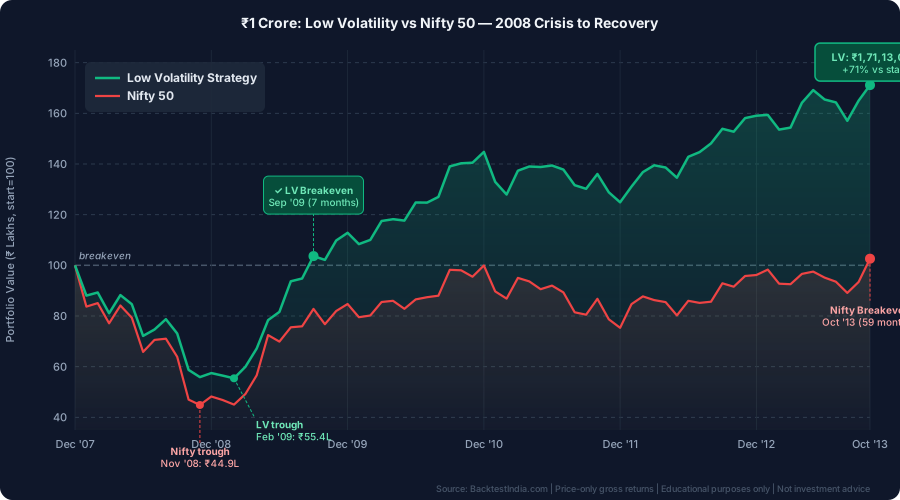
Price-only gross returns. No taxes deducted, no dividends included, for either strategy. ₹1,00,00,000 starting capital. Nifty 50 price index vs Low Volatility factor strategy (Top 100 NSE, PE>0, 30 least volatile stocks by 36M std dev, annual rebalance). Source: BacktestIndia.com / EODHD. Educational purposes only.
What Each Phase Actually Felt Like
January – March 2008: The correction that wasn't
You're down ₹12–19 lakh depending on the month. In Nifty you're down ₹15–23 lakh. The gap between the two is real but small — ₹3–4 lakh — and honestly, you're not focused on the comparison. You're focused on whether this is a "correction" or something worse. CNBC-TV18 is saying "decoupled from the US." You half believe it.
The low volatility stocks are doing what they always do: falling less, attracting less attention, generating fewer panic headlines. You're probably not even aware you're outperforming.
April 2008: The false dawn
Nifty bounces from ₹77L to ₹84L. LV bounces from ₹81L to ₹88L. Your brother-in-law — the one who told you not to invest in the first place — says "see, I told you it was just a correction." You start checking your portfolio less. You feel relief.
This is the false dawn that breaks people. Not the initial fall. The false hope.
May – June 2008: The entire bounce is gone
April's recovery is completely erased. In Nifty, you're now at ₹65.8L — down ₹34L. In LV, you're at ₹72.2L — down ₹27.8L. The ₹6.3L cushion is psychologically significant here. You're in bad shape either way, but one is worse than the other. And "worse" at this stage starts to determine who panics.
July – August 2008: The calm before Lehman
A small bounce. Nifty reaches ₹71L. LV reaches ₹78.7L — a ₹7.7L gap, the largest so far. There's a growing sense that maybe the worst is over. It isn't.
September 2008: Lehman
Lehman Brothers files for bankruptcy on September 15. The global financial system doesn't just wobble — it seizes. In the Indian market, Nifty closes September at ₹63.9L. LV closes at ₹73.1L. The gap is ₹9.2L, and it's about to widen dramatically.
Most investors are still holding. Surely, you tell yourself, surely it can't get worse than this.
October – November 2008: The actual bottom (for Nifty)
This is where Nifty hits its floor. ₹47L in October. ₹44.9L in November. More than half your money — gone. Your parents are saying we told you shares are gambling. Your spouse has started asking pointed questions about the children's education fund.
In Low Volatility, October is ₹58.7L and November is ₹55.9L. That's still terrible. Watching ₹44L disappear from a ₹1 Crore portfolio is stomach-turning — even if it's "only" ₹34L gone from the LV portfolio. But here's the thing: when you're staring at real numbers in your account — ₹55.9L vs ₹44.9L — that ₹11L difference is the difference between a bad situation and a desperate one.
💡 THE KEY INSIGHT
At the Nifty trough (November 2008), the LV portfolio had ₹11,02,000 more than the Nifty portfolio. At that moment, under maximum stress, that difference determines whether you hold or sell. The investor with ₹55.9L in their account has more room to breathe than the investor with ₹44.9L. Small advantages in a crisis compound into very different decisions.
December 2008 – February 2009: LV's own trough
Here's something the summary stats don't show: Nifty and LV hit their troughs at different times. Nifty bottomed in November 2008. LV kept sliding slightly, reaching its own worst point in February 2009 at ₹55,41,000 (−44.6%).
At that exact moment — February 2009, both at their worst — Nifty was at ₹45.0L and LV was at ₹55.4L. A ₹10.4L gap. Then the paths diverged completely.
The Recovery: 7 Months vs 59 Months
From the LV trough in February 2009 to the moment LV crossed back above ₹1 Crore: seven months. From the Nifty trough in November 2008 to the moment Nifty crossed back above its starting value: fifty-nine months.
Here's what the seven-month LV recovery looked like, compared to Nifty in the same period:
| Month | Low Volatility | Nifty 50 | LV Advantage |
|---|---|---|---|
| Feb 2009 (LV trough) | ₹55,41,000 | ₹45,02,000 | +₹10,39,000 |
| Mar 2009 | ₹59,96,000 | ₹49,21,000 | +₹10,75,000 |
| Apr 2009 | ₹67,18,000 | ₹56,59,000 | +₹10,58,000 |
| May 2009 (election results) | ₹78,40,000 | ₹72,47,000 | +₹5,92,000 |
| Jun 2009 | ₹81,61,000 | ₹69,90,000 | +₹11,71,000 |
| Jul 2009 | ₹93,68,000 | ₹75,53,000 | +₹18,15,000 |
| Aug 2009 | ₹94,80,000 | ₹75,95,000 | +₹18,85,000 |
| Sep 2009 ✅ LV crosses ₹1 Crore | ₹1,03,64,000 | ₹82,82,000 | +₹20,82,000 |
Price-only gross returns. Educational purposes only.
September 2009. Seven months from its own worst point, the low volatility portfolio is back above ₹1 Crore — at ₹1,03,64,000. The Nifty portfolio is at ₹82,82,000. Still ₹17L below where it started.
The LV investor at this point is whole. Not just emotionally — literally whole. Every rupee is back. The Nifty investor is facing a question that requires real fortitude to answer honestly: how much longer can you hold?
The Long Game: What Happened After
| Milestone | Low Volatility | Nifty 50 | Context |
|---|---|---|---|
| Dec 2007 — both start | ₹1,00,00,000 | ₹1,00,00,000 | Both at peak |
| Nov 2008 — Nifty trough | ₹55,90,000 | ₹44,88,000 | Nifty worst point |
| Feb 2009 — LV trough | ₹55,41,000 | ₹45,02,000 | LV worst point |
| Sep 2009 — LV breakeven | ₹1,03,64,000 ✅ | ₹82,82,000 | LV is whole. Nifty still -17% |
| Dec 2009 | ₹1,12,85,000 | ₹84,72,000 | +13% vs −15% |
| Dec 2010 | ₹1,44,76,000 | ₹99,93,000 | +45% vs −0.1% |
| Dec 2011 — Eurozone crisis | ₹1,24,87,000 | ₹75,33,000 | LV holds. Nifty −25% |
| Dec 2012 | ₹1,59,06,000 | ₹96,21,000 | +59% vs −4% |
| Oct 2013 — Nifty breakeven | ₹1,71,13,000 | ₹1,02,62,000 ✅ | Nifty took 59 months. LV is up 71%. |
| Nov 2014 | ₹2,38,99,000 | ₹1,39,93,000 | +139% vs +40% |
Price-only gross returns. No taxes deducted, no dividends included. Educational purposes only.
The Part That Changes How You Think About This
The December 2011 number deserves special attention. By then, investors who had held Nifty through 2008-2009, who had watched it crawl from ₹44.9L back toward ₹1 Crore over three grinding years — they were almost back to breakeven. December 2010 had brought Nifty to ₹99.9L, just ₹10,000 short of whole after three years of holding.
Then the Eurozone crisis. Nifty dropped back to ₹75.3L in December 2011. Three years of patience, and they were still ₹25L below their starting point.
That December 2011 moment is where many long-term Nifty investors actually capitulated. Not in 2008. After three years of holding, just as breakeven was within reach, the market crashed again.
The LV investor in December 2011? At ₹1,24,87,000. Already 25% above their starting point. The Eurozone crisis hurt them too — they were down from a December 2010 high of ₹1,44,76,000. But they were still well above breakeven, and they never faced the particular psychological horror of "three years of waiting, almost whole, then a second crash before breakeven."
📍 THE OCTOBER 2013 MOMENT
October 2013. Nifty closes above its December 2007 starting value for the first time. 59 months after its November 2008 trough. Nearly five years.
LOW VOLATILITY
₹1,71,13,000
+71% above starting capital
NIFTY 50
₹1,02,62,000
+2.6% above starting capital (after 6 years)
Same ₹1 Crore. Same market. Same economy. Same crisis. The difference: which stocks were in the portfolio.
What This Analysis Does Not Tell You
This is a historical analysis of a single crash. Before drawing any conclusions, these limitations matter:
1. This is one period. The 2008 crisis was an extreme event — a global financial system near-collapse. Low volatility strategies don't outperform in every environment. The full 18-year backtest shows the strategy underperformed in 2022 due to overweight in rate-sensitive sectors. No strategy protects in every crash.
2. These are price-only gross returns. In real implementation, taxes and transaction costs apply. The full tax-aware analysis (LTCG/STCG) shows a net CAGR of 12.38% vs Nifty's 10.42% over 18.5 years — the advantage persists after taxes, but the numbers differ from what's shown here.
3. Survivorship bias is partially mitigated, not eliminated. The dataset includes delisted companies, but companies that failed before data coverage began are not included.
4. Past performance does not predict future results. If the low volatility anomaly gets widely arbitraged by institutional capital, the premium could compress.
5. This is not advice on what to do with your money. The right allocation for any individual depends on their full financial picture — goals, time horizon, other assets, income stability, and psychological risk tolerance. A SEBI-registered Investment Adviser can assess this for you. Find a SEBI-RIA →
What This Means for the Current Market
Nifty is down roughly 12% from its November 2024 high as of early 2026. FII outflows have been significant. The natural instinct is to ask: is this 2008?
The honest answer is that nobody knows. The 2008 crash had a specific cause — a global banking system collapse — that doesn't have a direct parallel in the current environment. The 2022 correction was about 11% and resolved within months. The 2020 crash was -28% and recovered in roughly 7 months. 2008 was -55% and took 5 years. The range of possible outcomes is wide.
What 18 years of data does tell us: if you're worried about a severe bear market, the question isn't just "should I stay invested" — it's also "what are you invested in?" Strategies designed for survivability tend to be more holdable during the crash, recover faster afterward, and leave you in a better position when the long-term compounding eventually reasserts itself.
You can test the current Low Volatility portfolio and run your own parameters at backtestindia.com →
Test This Strategy With Your Own Parameters
The numbers above used specific settings: Top 100, PE>0, 30 stocks, 36-month standard deviation, annual rebalancing. What if you changed the universe size? The number of stocks? The lookback period?
BacktestIndia.com lets you customise every parameter across 18+ years of NSE data — with automatic LTCG/STCG tax modelling included.
Run Your Own Backtest →10 free backtests per month · No login required to start
📚 Related Analysis
- Full 18.5-Year Low Volatility Backtest — 12.38% net CAGR vs Nifty's 10.42%, complete tax-aware analysis
- Momentum Factor in India — 14.01% CAGR but -70% max drawdown. The tradeoff explained.
- Lost Decade Rolling Returns — Low Volatility beat Nifty in 100% of 10-year rolling periods
- Factor Investing India: Complete Guide — All five factor strategies compared
⚠️ FULL DISCLAIMER
EDUCATIONAL ANALYSIS ONLY. All data in this article represents a historical backtest simulation using price-only gross returns. No taxes have been deducted and no dividends have been included for either strategy, to ensure a like-for-like comparison. This is not a representation of actual investor returns.
NOT INVESTMENT ADVICE. This article does not constitute investment advice, a recommendation to buy or sell any security, or a solicitation of any kind. The low volatility strategy described is a systematic, rules-based factor approach — not a stock tip or portfolio recommendation.
PAST PERFORMANCE. Historical backtest results do not guarantee future performance. Market conditions change. Factor premiums can compress or disappear.
CONSULT A PROFESSIONAL. Before making any investment decision, consult a SEBI-registered Investment Adviser who can evaluate your specific financial situation. Find a SEBI-RIA →
NOT SEBI REGISTERED. BacktestIndia.com is an educational tool. Content published under the proviso to Regulation 2(1)(l) and Regulation 4(a) of SEBI (Investment Advisers) Regulations 2013. Not a research report per SEBI RA FAQ No. 4 (July 2025).
DATA SOURCE: EODHD Financial APIs. Market data reflects closing prices. LV strategy: Top 100 NSE stocks by market cap, PE > 0, 30 stocks by lowest 36-month price standard deviation, equal weight, annual rebalancing. ©2026 BacktestIndia Research, BacktestIndia.com.